Omerza Orthodontics Lorain, Ohio

Appliances

The appliances, explained.

What each one does, what it feels like, and how long it stays, as plainly as we can put it. When how long depends on the child, we say so, and Dr. Omerza gives you your own numbers at the fitting.

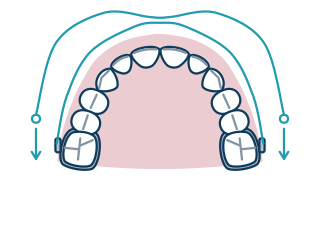
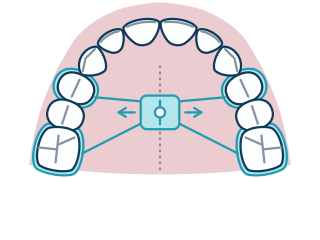
The upper teeth and palate seen from below with an expander: bands on the back teeth, arms to a screw in the middle of the palate, and arrows pointing outward.

First, the free look

Whether a child needs a growth appliance is decided at the free check-up, which the American Association of Orthodontists recommends by age seven. Usually the answer is not yet: at that age, says the AAO, "only a few orthodontic problems will need correction." When one is needed, it has one job, and it comes out when the job is done.

The first-phase tools the AAO names are palate expanders, tongue cribs and lingual arches. The rest of this page adds the growth appliances for big overbites and underbites, and the small parts that come with braces.

One at a time

What it does, what it feels like, how long.

Palatal expander

The upper teeth and palate seen from below with an expander: bands on the back teeth, arms to a screw in the middle of the palate, and arrows pointing outward.
Seen from below: the screw sits over the seam down the middle of the palate; the arrows show which way the halves go.
What it does
Widens a narrow upper jaw in a growing child. It is fixed to the upper back teeth with a small screw in the middle of the palate, and turning the screw eases the two halves of the upper jaw apart along the seam between them. It corrects a crossbite and makes room for crowded teeth, and it is one of the standard first-phase tools.
What it feels like
Pressure for a few days after it goes in and when the turns begin. Speech and swallowing feel odd for a few days and there is more saliva at first. A gap may open between the upper front teeth: that means it is working.
How long
Weeks of turning at home with a small key, then months of holding while new bone fills the widened seam. The numbers depend on how much width is needed, and you get your schedule at the fitting.

After growth the seam has fused. Widening an adult jaw takes an expander anchored to small screws in the bone, or surgery; the anchored kind now works for many adults, though the long-term evidence is still limited.
Herbst and the Forsus spring

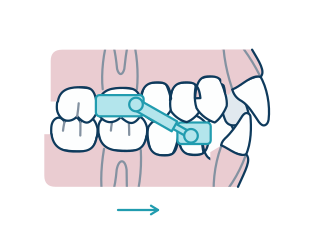
Side view of the teeth with a Herbst appliance: a tube fixed at the upper first molar and a rod fixed at a lower premolar, sliding into it, and an arrow showing the lower jaw held forward.
Tube on the upper molar, rod on a lower premolar, a pair on each side; the arrow is the lower jaw held forward.
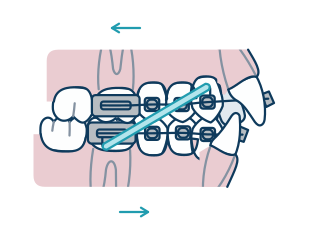
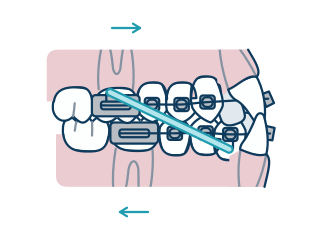
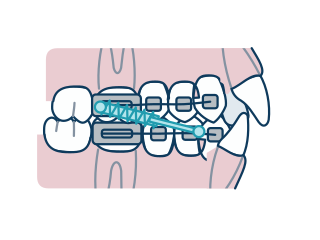
Side view of teeth in braces with a spring running from the upper first molar down to the lower wire just behind the canine.
The spring runs from the upper molar's tube to the lower wire, just behind the canine.
What it does
Both correct a large overbite, with the lower teeth sitting well behind the uppers (Class II), from inside the mouth. A Herbst appliance has a telescoping arm on each side that holds the lower jaw forward while a child grows. A Forsus spring is a spring-loaded rod on each side, fitted to the braces, that pushes the lower teeth forward and the upper teeth back. Neither comes out at home, so both work whether or not anyone remembers them.
What it feels like
The cheeks and lips get rubbed at first, and wax helps. Chewing feels strange and the jaw muscles may ache for a few days, then it settles.
How long
Months, while the bite corrects. Dr. Omerza gives you an estimate at the start; how the child grows decides the rest.

When to use one is a question of timing; Dr. Omerza has written about what the trials of early treatment settled.

Headgear and reverse-pull headgear

The upper teeth seen from below with a facebow: an inner wire hooked into tubes on the upper molar bands, an outer wire running back on both sides, and arrows showing the strap pulling back.
Seen from below: the inner bow fits tubes on the molar bands, and the strap pulls the outer bow back, the way the arrows point.
What it does
Both guide jaw growth from outside the mouth, in growing children. Headgear runs from the upper molars to a strap around the neck or head and holds back the upper jaw while the lower jaw catches up. Reverse-pull headgear is a face mask resting on the forehead and chin, with elastics to the upper teeth, that encourages an upper jaw that is behind the lower one to come forward, usually together with an expander.
What it feels like
Awkward more than painful. The teeth it pulls on are tender for the first few days, and it takes a few nights to sleep in.
How long
Worn at home and overnight, never at school, for a limited season while growth makes it work. It only works for the hours it is worn.

Space maintainers

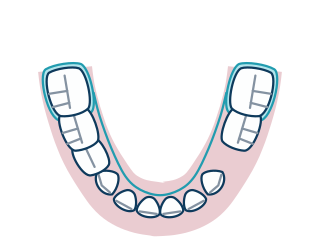
A child's lower teeth seen from above, with bands on the first molars and a thin wire behind the front teeth; on one side a baby molar is missing and its space is kept open.
Seen from above: the wire runs behind the front teeth from band to band; the gap on the right is the lost baby molar's room.
What it does
When a baby tooth is lost early, to decay or an accident, its neighbours drift into the gap and the adult tooth can be blocked. A space maintainer holds the gap: a band on a molar with a wire loop for a single space, or for more than one, a lower lingual arch (a thin wire behind the lower teeth from molar to molar) or a Nance holding arch (a wire with a small acrylic button against the roof of the mouth).
What it feels like
Very little after the first day or two. The tongue explores it, then forgets it.
How long
Until the adult tooth arrives, which the X-rays let us predict. Then it comes off.

Your family dentist often spots the need first: what we ask dentists to look for.

Habit appliances

What it does
A small crib or loop of wire fixed behind the upper front teeth that makes a thumb or finger habit, or a tongue that pushes forward, hard to keep up. A habit still going as the adult front teeth arrive can leave a gap between the front teeth when the back teeth meet: an open bite.
What it feels like
Speech and eating feel different for a few days. It is a reminder, not a punishment: it makes the old habit feel wrong.
How long
Until the habit has stopped for good, and a while longer so it stays stopped. Dr. Omerza decides when it comes out.

Why the tongue matters as much as the thumb: open bites and the tongue.

Separators and bands

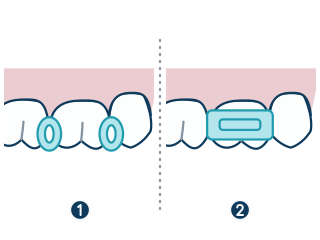
Two side views of the upper back teeth: small elastic rings between the first molar and its neighbors (1), and a steel band round the molar (2).
The rings open a sliver of room; then the band takes their place.
  1. Separators: small elastic rings between the teeth.
  2. A band: a thin steel ring cemented round the molar.
What it does
Bands are thin steel rings cemented around back teeth, usually the first molars, to anchor an expander, a headgear tube or the end of the archwire. Separators are tiny elastic rings slipped between the back teeth beforehand to open just enough room for the bands.
What it feels like
Separators make the back teeth feel tight and tender, like food caught between them, for a day or two; soft food helps. Bands feel snug for a few days.
How long
Separators stay until the bands go on, usually within a week or two. Bands stay as long as whatever they anchor. If a separator falls out early, call: it may need replacing before the band will fit.

Elastics

Side view of teeth in braces with a rubber band from a hook at the upper canine to a hook on the lower first molar, and arrows: upper teeth back, lower teeth forward.
Upper canine hook to lower molar hook. The arrows show the pull: upper teeth back, lower teeth forward.
Side view of teeth in braces with a rubber band from a hook at the lower canine to a hook on the upper first molar, and arrows: upper teeth forward, lower teeth back.
Lower canine hook to upper molar hook: the pull runs the other way.
What it does
Small rubber bands hooked between the upper and lower braces. They do the bite correction braces alone cannot: drawing the lower teeth forward against the uppers for an overbite, the reverse for an underbite, closing an open bite, or lining up the midlines.
What it feels like
The teeth are tender for the first few days of each new pattern, and opening wide takes a little care until you are used to them.
How long
As long as the bite takes to correct, worn exactly as prescribed (usually day and night) with fresh ones as often as we say. Worn "mostly", they add months: the AAO consent form warns that treatment time "may be lengthened if ... patient cooperation is not adequate."

For an overbite, Dr. Omerza may ask you to wear them until your upper and lower front teeth meet edge to edge, then call us and stop. The bite settles back a little over the next few weeks, which is why it is overcorrected on purpose.

Living with them day to day: living with braces.

And the three you may know

Braces, aligners and retainers.

The main tools for moving teeth and keeping them, each with a page of its own.

Sore days, whatever the appliance

Pressure or tenderness for a few days after an appliance goes in or is adjusted is normal, the AAO says. A warm salt-water rinse (half a teaspoon of salt in a cup of warm water) or an over-the-counter pain reliever, taken as the package directs, usually helps, and orthodontic wax covers anything that rubs.

Call if it is no better after a few days, if something comes loose, or if a part is sharp, cracked or badly bent. Do not keep wearing a removable appliance that is.

Wondering whether your child needs one?

The check-up is free, and most of the time the answer is not yet. When it is yes, you hear why, for how long and what it costs.

Office hours

Monday7:30 am – 5 pm
Tuesday – Thursday7 am – 4:30 pm
Friday7 am – 12 pm
Saturday – SundayClosed

1740 Cooper Foster Park Rd W, Lorain. Free parking at the door.