Glossary
Orthodontic words, plainly.
46 words you may hear in the chair, in a letter or on this site, one or two sentences each. If we use one you do not know, stop us and ask; nobody minds.
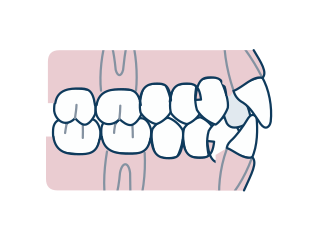
A
- Adjustment
- A routine visit during treatment, usually every six to ten weeks, when the wire is changed or adjusted and progress is checked.
- Aligner
- A thin, clear, removable tray made from a scan of the teeth. A series of them, each slightly different, moves the teeth a little at a time, worn twenty to twenty-two hours a day. See clear aligners.
- Archwire
- The thin, springy wire that runs through the brackets. It is shaped to the ideal arch and, slowly, carries the teeth toward it.
- Attachment
- A small tooth-coloured bump bonded to a tooth during aligner treatment, giving the tray something to push against; polished off at the end. Also the small button an oral surgeon bonds to an uncovered canine so it can be guided in.
B
- Band
- A thin steel ring cemented around a back tooth, usually a first molar, to anchor an expander, a headgear tube or the end of the archwire.
- Bonded retainer
- A thin wire glued behind the front teeth, usually the lower ones, that holds them without anyone having to remember it. Clean under it with a floss threader. See retainers.
- Bonding and debonding
- Bonding is gluing the brackets to the teeth: braces on. Debonding is taking them off and polishing the teeth clean: braces off, and the day the retainers start.
- Bracket
- The small metal or tooth-coloured ceramic piece bonded to each tooth, with a slot that holds the archwire. See braces.
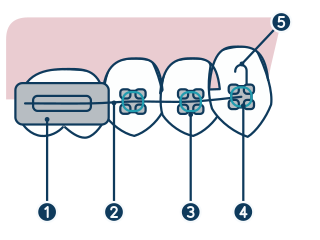
What is on the teeth, from the back of the mouth forward. - Band: a thin steel ring cemented round a back tooth, with a tube for the end of the wire.
- Archwire: the springy wire that does the steering.
- Bracket: the small square bonded to each tooth.
- Tie: the little elastic ring that holds the wire in the bracket, the part you pick colors for.
- Hook: where a rubber band (an elastic) attaches.
C
- Cephalometric X-ray
- A side view of the head and jaws, used to measure how the jaws relate to each other and to the skull, and how they are growing. Taken when a plan depends on it.
- Class I, Class II, Class III
- How orthodontists describe the way the upper and lower first molars meet. Class I: they meet normally, even if the teeth are crowded. Class II: the lower teeth sit back from the uppers, the usual large overbite. Class III: the lower teeth sit ahead, an underbite. See overbites and underbites.
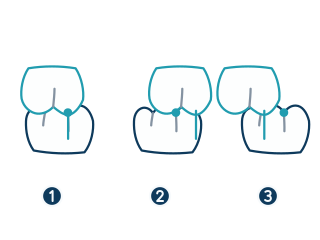
The class describes only how the first molars meet, front to back. - Class I: the upper molar's front cusp lands in the lower molar's groove.
- Class II: the upper molar sits ahead of the groove, the lower one behind.
- Class III: the upper molar sits behind the groove, the lower one ahead.
- Clear retainer
- A thin clear plastic retainer, shaped with heat over a model of the teeth, that covers every tooth. Never in hot water: heat made it, and heat will warp it.
- Crossbite
- Upper teeth biting inside the lower teeth instead of outside them, at the front or the side. In a child, a narrow upper jaw is a common cause, and an expander a common fix while the jaw is still growing. See crossbites.
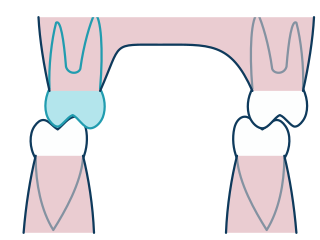
Right: as it should be. Left: the upper molar bites inside the lower one, often because the upper jaw is narrow. - Crowding
- Too little room for the teeth, so they overlap, turn or are blocked from coming in. Mild crowding can often be resolved in eight to twelve months, the AAO says. See crowding.
D
- Diastema
- A gap between two teeth, most often the upper front pair. Closed with braces or aligners, then held with a retainer. See spacing and gaps.
- Digital scan
- A 3-D model of the teeth made with a small handheld camera instead of a tray of impression material. In a 2021 review of nine studies, every one found some benefit in its favour.
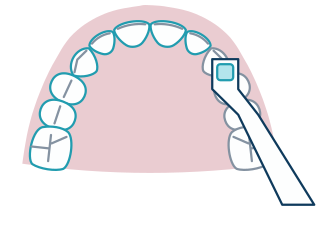
Seen from below: the teeth outlined in color are already on the screen as a 3-D model.
E
- Elastics
- Small rubber bands stretched between hooks on the upper and lower braces to correct the bite. They work only when they are worn as prescribed. See elastics.
- Eruption
- A tooth coming in: moving through the bone and gum into its place in the mouth. A tooth that cannot erupt on its own is impacted.
- Expander
- An appliance fixed to the upper back teeth with a small screw in the middle, turned with a key to widen a narrow upper jaw in a growing child. See palatal expanders.
- Extraction and non-extraction treatment
- Whether some teeth, usually premolars, are removed to make room or to correct the bite, or all the teeth are kept and aligned. The choice depends on the crowding, the bite, the lips and the profile; when teeth do come out, your family dentist or an oral surgeon removes them.
H
- Hawley retainer
- The classic removable retainer: a wire across the front teeth and an acrylic plate behind them. Sturdy and adjustable.
- Headgear
- An appliance worn at home and overnight that guides jaw growth from outside the mouth in a growing child. Regular headgear holds the upper jaw back; reverse-pull headgear, a face mask, brings an upper jaw that is behind forward. See headgear.
- Herbst appliance
- A fixed appliance with a telescoping arm on each side that holds the lower jaw forward while a child grows, to correct a large overbite. See the Herbst.
I
- Impacted tooth
- A tooth stuck below the gum that cannot come in on its own, most often a wisdom tooth or an upper canine. A canine can often be helped: a baby tooth removed in time, or the tooth uncovered by an oral surgeon and brought down with braces. See the canine that won't come in.
- Interceptive treatment
- Treatment started early, while a child has a mix of baby and adult teeth, to stop a developing problem getting worse: an expander for a crossbite, a space maintainer, a habit appliance. "Interception" is in the ADA's own definition of orthodontics.
- Interproximal reduction (IPR)
- Polishing a sliver of enamel from between two teeth to make a little room or improve their shape, most often during aligner treatment.
L
- Ligature
- The tiny elastic ring, or thin wire tie, that holds the archwire in a bracket's slot. The coloured ones are the colours patients pick at each visit.
M
- Malocclusion
- A bite in which the teeth or jaws do not meet as they should. The ADA defines orthodontics as the specialty of "the diagnosis, prevention, interception, and correction of malocclusion."
- Mouthguard
- A soft guard worn over the teeth for sport. With braces, a guard made to fit over them is, in the AAO's words, "strongly recommended"; we fit them here.
O
- Open bite
- The back teeth meet but the front teeth do not, leaving a gap. A thumb habit, a tongue that rests between the teeth or the way the jaws grow can cause it, often more than one. See open bites.
- Orthodontics
- The dental specialty that diagnoses, prevents, intercepts and corrects bites, including the way the jaws grow; its full name is orthodontics and dentofacial orthopedics. An orthodontist is a dentist with at least two more years of accredited training in it. See why an orthodontist.
- Orthognathic surgery
- Jaw surgery, by an oral and maxillofacial surgeon working with the orthodontist, for bites where the jaws themselves are the problem; braces before and after, usually once growth has finished. See when jaw surgery is the honest answer.
- Overbite
- How far the upper front teeth overlap the lower ones, top to bottom. Some overlap is normal; a deep bite, where the lower front teeth disappear behind the uppers, is worth treating. People often say overbite when they mean overjet.
- Overjet
- How far the upper front teeth stick out ahead of the lower ones, front to back. A large overjet puts those teeth at risk of a knock.
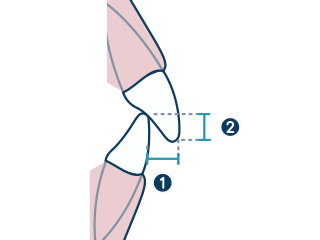
Two measurements people mix up: one front to back, one top to bottom. - Overjet: how far the upper front teeth sit ahead of the lower ones.
- Overbite: how far the upper front teeth overlap the lower ones.
P
- Panoramic X-ray
- One wide X-ray that shows every tooth and its roots, including the teeth still forming in the jaws. It is how canines and wisdom teeth are seen long before they show.
- Primary and permanent teeth
- Primary teeth are the twenty baby teeth; permanent teeth are the adult ones, thirty-two counting the wisdom teeth. Around age seven most children have a mix of both, which is why the AAO recommends a first orthodontic check-up by then.
R
- Relapse
- Teeth drifting back toward where they started after treatment. Ordinary biology, not anyone's failure: teeth move throughout life, which is why retainers are for life. See retainers.
- Retainer
- What holds the teeth in place after braces or aligners come off: clear, Hawley or bonded. Two weeks full time, then every night. See retainers.
- Retention
- Everything after active treatment: the retainers, the checks, and the habit of wearing them. In practice, the rest of your life.
S
- Separators
- Tiny elastic rings placed between the back teeth for a few days before bands go on, to open just enough room. The teeth feel tight for a day or two. See separators and bands.
- Space maintainer
- An appliance that holds the gap left by a baby tooth lost early, so the adult tooth has room to come in. See space maintainers.
- Spacing
- Gaps between teeth, from teeth that are small for the jaw, teeth that never formed, or a tongue or habit pushing them apart. See spacing and gaps.
T
- TAD (temporary anchorage device)
- A small screw placed in the bone for a few months as an anchor that does not move, so teeth can be pulled against it; removed when the job is done. In a 2018 review of 46 studies, about one in seven came loose before then.
- Two-phase treatment
- A short first phase in a child, often an expander or another appliance, then a rest, then full braces or aligners once most adult teeth are in. The AAO notes that many problems can be treated in a single phase. See one phase or two.
U
- Underbite
- The lower front teeth sit ahead of the uppers when you bite (Class III). Worth an early look in a growing child. See underbites.
W
- White spot lesion
- A chalky white mark where plaque sat on the enamel long enough to start dissolving it: the first stage of a cavity. The AAO is clear that braces do not create these spots on their own; plaque left around the brackets does. Brushing prevents them. See living with braces.
- Wisdom teeth
- The third molars, the last teeth to come in. A 2023 review found no proven link between lower wisdom teeth and crowding of the lower front teeth after treatment, and no case for removing them to prevent it.
The appliances, explained
Expanders, Herbst appliances, headgear, space maintainers and the small parts, in plain words.
MoreThe cases we see
Crowding, overbites, underbites, crossbites, open bites and the rest: when to start and how.
MoreQuestions & answers
Cost, timing, the age-seven check-up, braces or aligners.
MoreStill sounds like another language?
Come in and we will explain it on your own teeth. The first visit is free.
Office hours
| Monday | 7:30 am – 5 pm |
|---|---|
| Tuesday – Thursday | 7 am – 4:30 pm |
| Friday | 7 am – 12 pm |
| Saturday – Sunday | Closed |
1740 Cooper Foster Park Rd W, Lorain. Free parking at the door.